Bulkington Books

colophon · the parts of a book

The parts have names. We keep them.

The parts of a book have names older than printing itself. A restorer ought to know the body he mends. Here is our standing glossary — added to as we go — and, we’re told, the part of the house most passers-by come to read.

anatomy of a book

From frontispiece to colophon.

Frontispieceˈfrʌn.tɪ.spiːs
An illustration facing the title page — the reader’s first visual encounter with the book’s world. Often an engraving of the author, a key scene, or an allegorical figure. The frontispiece is the book’s face.
Half-titlethe quiet introduction
A page bearing only the title — no author, no publisher, no ornament. It precedes the title page like a whisper before a speech. Originally it protected the title page during binding.
Title pagethe book’s birth certificate
The formal declaration of a book’s identity: title, author, publisher, and year. Before dust jackets existed, the title page was the only advertisement a book had — and it was often typographically magnificent.
Endpaperthe book’s lining
The decorative sheets pasted inside the covers — often marbled, sometimes plain. The endpaper is where a previous owner might paste a bookplate, or where a child writes their name.
Gutterˈɡʌt.ər
The inner margin where facing pages meet the spine. Too narrow and the words vanish into the binding; too wide and the spread feels extravagant. The gutter is a book’s breath.
Deckle edgeˈdek.əl
The soft, feathered edge left where handmade paper met the frame of the mould. Machines trim it flat; we leave it ragged where we can, because the hand that made the sheet is worth seeing.
Foxingˈfɒk.sɪŋ
The rust-brown freckling that age brings to old paper, from iron in the pulp meeting damp air over decades. Not damage so much as a book keeping time — the reason our pages are cream and never white.
Colophonˈkɒl.ə.fɒn
The printer’s closing note — the maker’s mark at the end of a book rather than the front. It records who set the type, in what face, and where the work was done. Ours is a signature, not an afterthought.

the scribes before us

They left their mark. So do we.

The medieval scribes closed their manuscripts with a prayer, a sigh of relief, or a blessing. These are some of the finest — collected across languages and centuries.

Latinmedieval scribe’s prayer
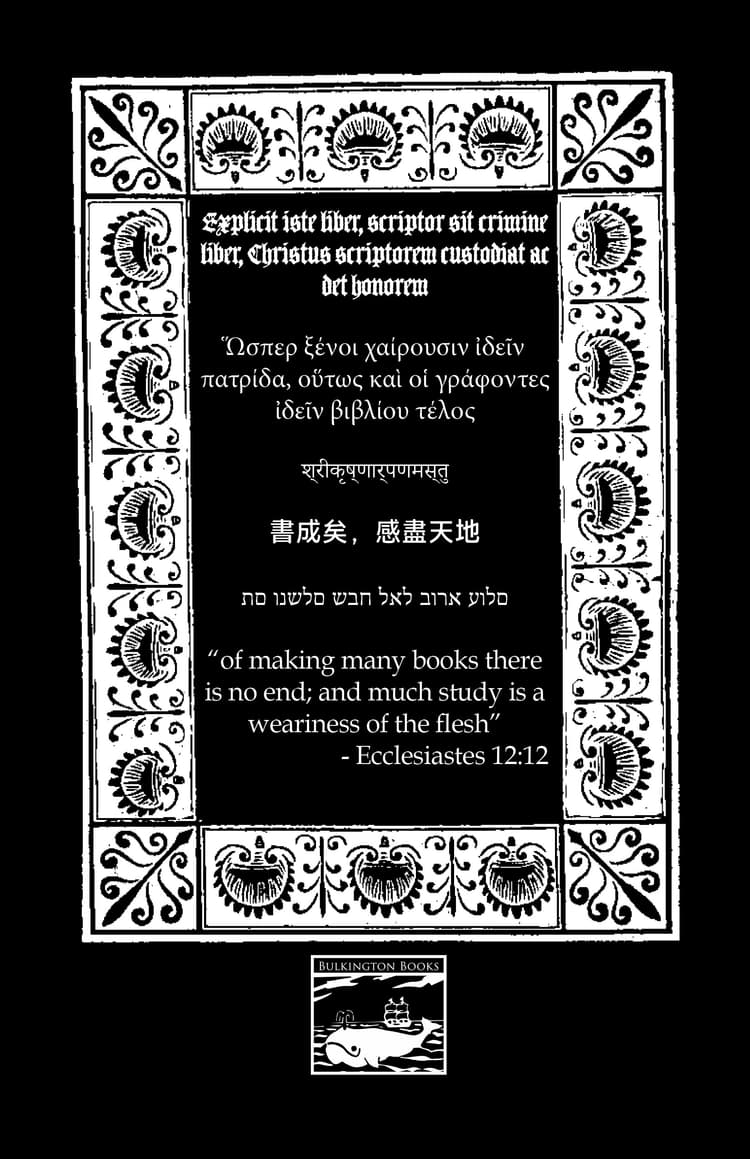
Explicit iste liber, scriptor sit crimine liber, Christus scriptorem custodiat ac det honorem.
“Here ends this book; may the writer be free from sin. May Christ protect the writer and give him honor.”
Greekthe traveler’s joy
Ὥσπερ ξένοι χαίρουσιν ἰδεῖν πατρίδα, οὕτως καὶ οἱ γράφοντες ἰδεῖν βιβλίου τέλος.
“As travelers rejoice to see their homeland, so too do writers rejoice to see the end of a book.”
Sanskrita devotional offering
श्रीकृष्णार्पणमस्तु
“Let this be an offering to Lord Krishna.”
Chinesegratitude upon completion
書成矣,感謝天地
“The book is complete; thanks be to Heaven and Earth.”
Hebrewthe scribe’s thanks
A prayer of thanks to the Almighty who has enabled this discourse.
“Rock of Israel — guard the writer who has completed his task. Praise to God who has bound together these pages.”
Englishecclesiastes 12:12
“Of making many books there is no end; and much study is a weariness of the flesh.”

our colophon

The maker’s mark.

Set in Abril Fatface (display), EB Garamond (body), and IM Fell English (accent). Printed to screen by lamplight. Built with Next.js, hosted on Vercel, files on Cloudflare R2.

The books themselves are sourced from the Internet Archive, Google Books, the Library of Congress, HathiTrust, Project Gutenberg, and other public-domain archives. Each edition is retypeset, corrected, and restored by hand — the editorial work is listed on every book page.

May the reader who opens this be kinder than the century that closed it — requiescant in pace the authors, and long may their sentences keep the light.

historical colophons · the tradition

They signed the work. So do we.

The colophon predates the title page by centuries. The earliest printed books — Fust and Schöffer’s Psalterof 1457, the first book to carry a printer’s mark — ended with a colophon declaring who made the thing and where. It was a point of pride: the work is done, the maker stands behind it.

We are collecting historical colophons — printer’s marks, closing notes, and maker’s devices from across the centuries. This gallery will grow as we find them in the archives.

Gallery forthcoming. If you have a colophon worth preserving, write to us.

cite this

Bulkington Books. “Colophon: the parts of a book.” Bulkington Books, 2025. https://bulkingtonbooks.com/colophon.